
A long time back I wrote about games I'd played that appealed to the programmer in me. Recently I came across some new ones which piqued my interest, so I thought I'd share links again. Because maybe some of you will enjoy these too...
Code: Terraform
 url copied!
First up is Code: Terraform. The conceit here is that you're terraforming a planet, but you're not on it. So the way you interact with the world is via python-like code.
For example, one of the early tasks is that your scanners have examined a big grid of the planet, and detected useful resources. You have a robotic rover which can move about and collect things for you, but it doesn't have any smarts, and there are some rules about how much "heat" it generates moving over the terrain. So you need to write some logic to try and collect all the stuff, manage the heat and do it all relatively efficiently...

The early puzzles are teaching the basic mechanics of "how do you access the data for this puzzle" and the language being used. Solving them by brute force can work, but later ones require some more optimised thinking as the code involved doesn't run particularly fast.
And there's a range of different puzzles, which you can pick up and put down as you like. Some are "automating the base(s)" tasks: driving rovers, automating scientific research or optimising use of resources. And some are "earning money" things which are a bit more abstract. Cracking a code, solving a maze or the like.
Generally if you've enjoyed things like "Advent of Code" or the like before, this might appeal.
Turing Complete
url copied!
At the other end of the scale, Turing Complete is a game that starts off as a logic puzzle based around digital circuits. But it ends up with you "building" (simulating) a working computer and getting you to write code against it.

Early puzzles teach basic digital logic, and play with the idea that if you have one type of logic gate, you can use it to make other types. You get given a "truth table" (the inputs you'll get and the desired outputs) and you have to wire up the circuit that achieves this response. As you progress the scale of the work changes. Puzzles start to deal with 4 or 8 bit devices. Then to data-bus scenarios where it's numbers rather than bits being processed.
I suspect I quite liked this because I did a lot of this type of thing when I was at university, and some of the Steam reviews suggest it could be a teaching tool for digital electronics. I found Karnaugh Maps (a thing I'd not thought about since I was studying) to be very helpful for early levels.
There are a few levels where the descriptions of what you need to do were a bit fuzzy for me to grasp quickly. But overall it's a fun way of wrapping up a learning (or remembering) experience.
Factorio started a trend...
url copied!
When I wrote about Factorio last time, it was a fairly unique idea. (to me, at least) But since then, the "belt driven, factory automation and optimisation" concept has spawned a lot of other games. And a few of those have filled chunks of my spare time. For the "kind of the same idea, but in 3d" concept Satisfactory has been the best I've played. And the prettiest too.

This does away with the procedurally generated map of Factorio, but the more hand-built approach does make for some other interesting challenges. And despite that it certainly feels like it has the scale of a planet. But for the more medievally minded automation obsessive, Alchemy Factory can be entertaining. This keeps everything in a much smaller space, but has a more economic approach as you're trying to automate making (and eventually selling) wares for in your shop. And for a more cutesy, story-driven game using factory optimisation mechanics there's Little Rocket Lab. While you need to use factory-type machines to solve "make 10000 of this thing" demands, this also has more plot-driven aspects like "use your belts to move this <very heavy thing> from A to B" for variety. And I'm sure there are many more interesting games if you go looking...
Sand is a thing now?
url copied!
Kind of related to the Factorio "optimisation and exploration" thing, there's also Sandustry. While this has some "you need to make a factory-type flow with belts and devices to process things" elements, it relies on "simulated sand physics" at a per-pixel level. Powders, liquids, gasses and the like are all simulated in this side-on-2D world. So instead of "put cogs on a conveyor" you're moving the earth you dug up to devices that pan it for gold, and process the results. And that gives you money (and other things) spend on upgrades to open up new mechanisms. It's not aiming for the same scale or optimisation obsession that the games above do, but you still have to fit your structures into available spaces.
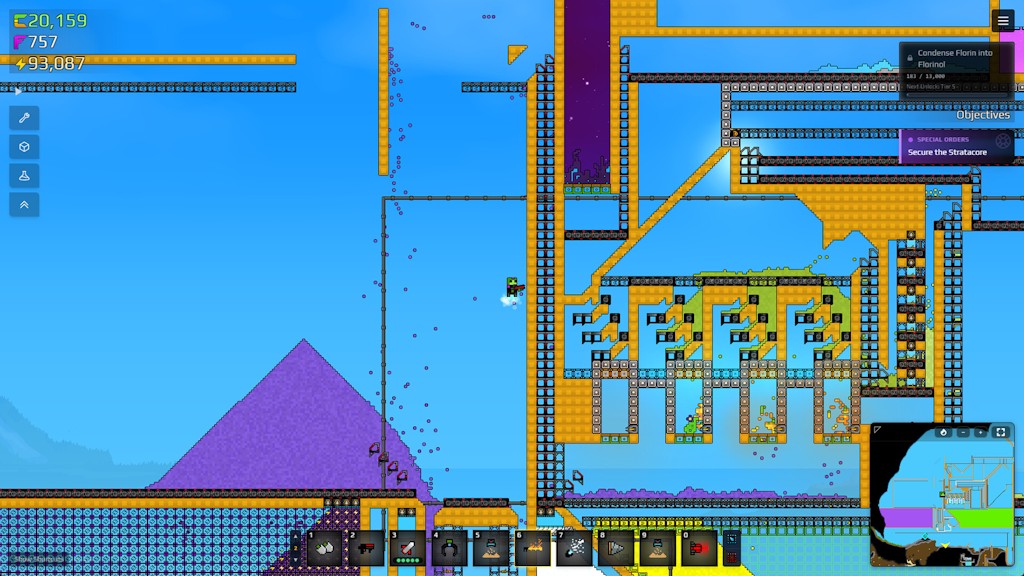
Following a similar physical simulation trend, if you're a chemistry nerd, have a look at AtomCraft. While this starts with digging pixels in a similar way, it leans in really heavily to the chemistry of the world. Progression is through using stuff you mined along with tools (and fire) to make new compounds and alloys. The goal is repairing your spaceship, but I've just found working out the reactions a great distraction.
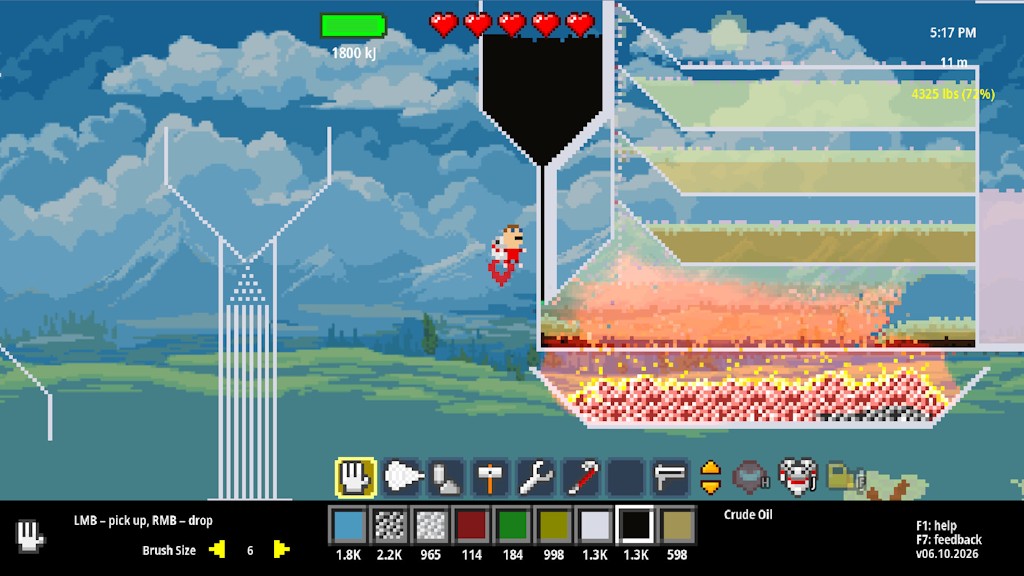
For example you can burn wood to get charcoal, and burn that to melt iron ore into iron, and then add carbon to make steel. All of which requires you to have clay, to make walls of your reaction machine which can be "baked" hard by the fire. You get into fairly complex multi-stage reactions that involve solids, liquids and gases as it develops. Like Sandustry, this is still in development - the latest releases are starting to get into lasers and nuclear physics stuff - though I've not got to that level of progression yet.
And finally...
url copied!
Fancy a bit of crime solving and databases? Who doesn't! So how about a puzzle game where the core mechanic is using database queries to discover who's responsible for crimes?
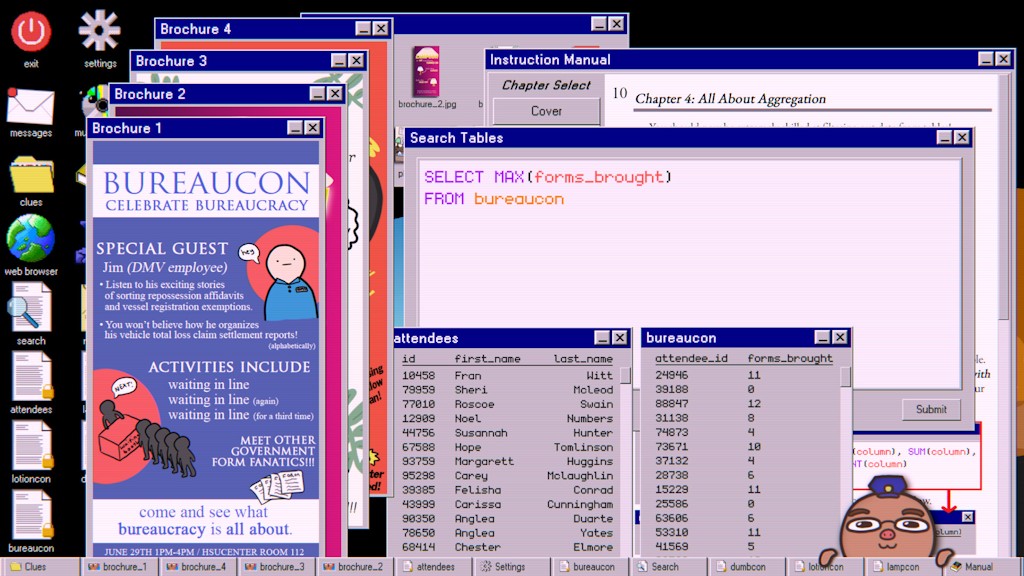
That's what Database Detective: Minor Crimes Division does - in its own quirky way. But the underlying idea is puzzles based around how you can extract and filter data from a variety of datasources. All in a quirky cartoon style. I doubt it's going to teach people reading this anything new, but it's an amusing distraction using skills you might already have...
↑ Back to top